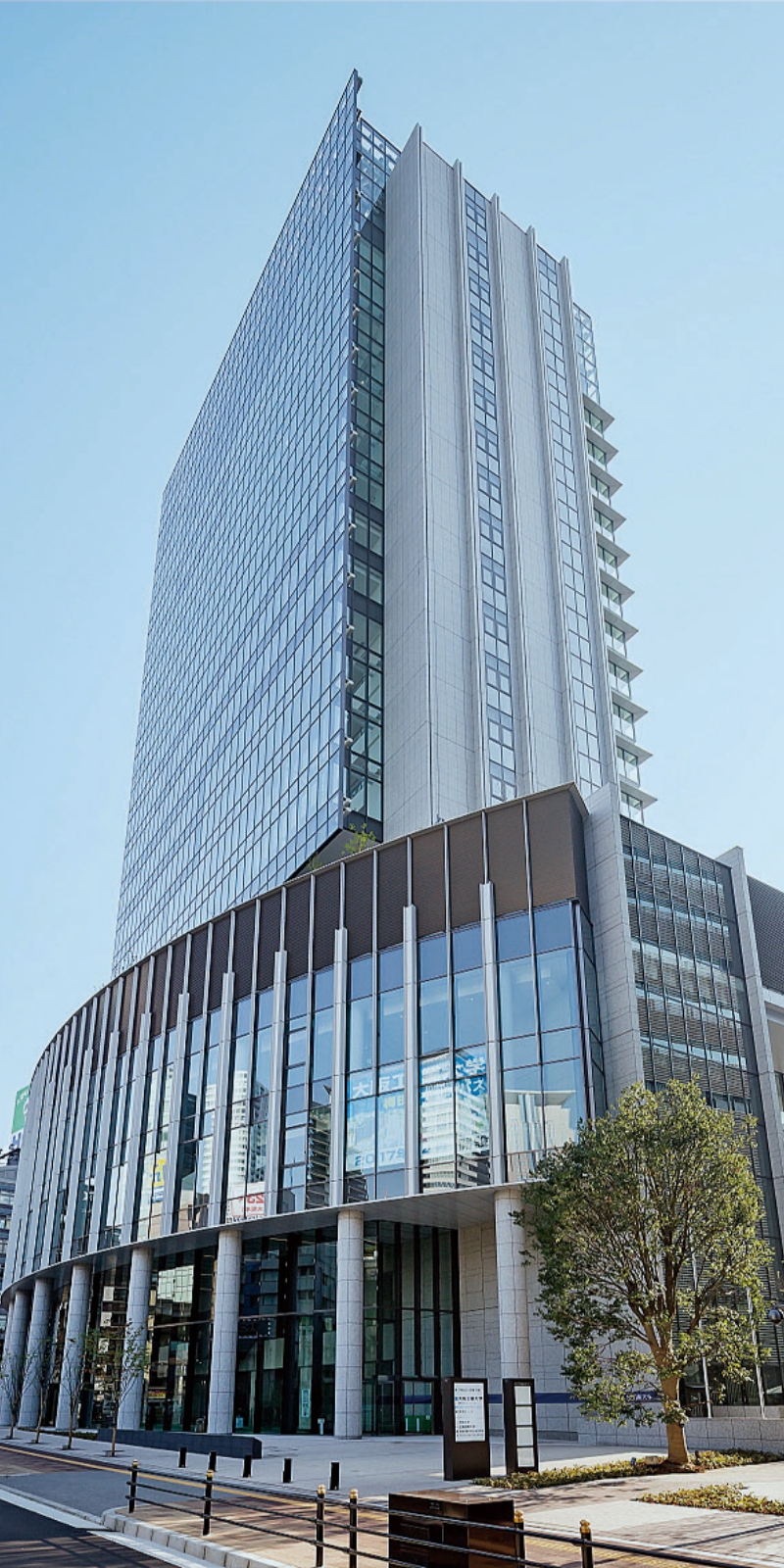






The Applied Chemistry, Environmental and Biomedical Engineering has three courses: "Applied Chemistry," "Environmental Engineering," and "Life Sciences." Students generally study the same specialized field as their home department, but can also study the content of other courses in an interdisciplinary manner.
The Applied Chemistry, Environmental and Biomedical Engineering consists of a wide range of technical fields, but the fundamental technologies have commonalities. Therefore, in this department, we have established the "Substances and Materials Field", the "Environmental Solutions Field", and the "Life, Medical and Food Engineering Field" to further enhance the expertise acquired in the undergraduate program, and we have also established a "Cross-disciplinary" program to learn a wide range of fundamental technologies.
The Applied Chemistry, Environmental and Biomedical Engineering consists of a wide range of technical fields, but the fundamental technologies have commonalities. Therefore, in this department, we have established the "Substances and Materials Field", the "Environmental Solutions Field", and the "Life, Medical and Food Engineering Field" to further enhance the expertise acquired in the undergraduate program, and we have also established a "Cross-disciplinary" program to learn a wide range of fundamental technologies.
Our goal is to develop specialists and highly skilled engineers who can comprehensively understand and use the technologies related to these three fields.
Applied Chemistry Course
In the Applied Chemistry course, students will acquire knowledge and methodology related to atoms and molecules, which form the basis of applied chemistry, and improve their skills to be involved in the development of organic, inorganic, and polymeric materials.
-
Key Points of the Applied Chemistry Course

01 Develop problem-solving skills by carrying out research that you have designed yourself
In addition to acquiring specialized knowledge of chemistry and mastering the operation of analytical equipment, students will plan their own experiments and improve their problem-solving skills. In this course, we will advance research with the keywords "decarbonization" and "beauty and health" and contribute to the realization of a sustainable society.
02 Building a collaborative research network to support active research activities
In collaboration with domestic and international universities, research institutes, and industry, you can conduct research using cutting-edge technology such as SPring-8. Not only can you contribute to the construction of an academic information infrastructure and the advancement of research, but you can also build personal connections through interactions with experts and researchers related to your research activities.
03 Cultivating a global perspective through international exchange with research institutes overseas
Using our university's overseas research support program, students are sent to joint research partners and partner universities. This allows students to come into contact with cutting-edge research and technology, which in turn increases their motivation to do research. In addition, through international exchange with overseas research institutions, students can develop a global perspective by coming into contact with different languages, cultures, and values, and build mutual trust.
04 Giving back to society by participating in domestic and international conferences and publishing results in academic journals
Students will learn research ethics, methods for disseminating information, and paper writing, and will present their research results at domestic and international conferences and in academic journals, where researchers and experts from around the world gather. Through communication activities in which they exchange ideas with other researchers, they will deepen mutual understanding and contribute to society by disseminating new knowledge to the world.
Environmental Engineering Course
In the Environmental Engineering course, students will acquire the fundamental knowledge and methodologies of environmental engineering and enhance their skills to engage in resource and energy, urban metabolism, and coexistence with nature.
-
Environmental Engineering Course Points

01 Research that scientifically analyzes complex environmental issues from multiple perspectives and leads to solutions using cutting-edge technology.
Through education and research centered on "environmental solutions fields" such as resources and energy, urban metabolism, and coexistence with nature, we cultivate individuals who possess solid research capabilities and a broad perspective, enabling them to contribute to the sustainable development of society.
02 "Resources and Energy": Aiming for highly efficient use of resources and energy to support a decarbonized society.
We conduct research on energy-saving technologies, energy conversion technologies, and energy creation technologies to improve energy efficiency and reduce greenhouse gas emissions.
03 "Urban Metabolism" : Aiming to realize sustainable urban and social infrastructure.
We engage in education and research related to the preservation and creation of urban environments and the construction of sustainable urban systems through water and sewage systems, waste treatment and resource recycling, and water environment conservation.
04 "Coexistence with Nature": We aim to realize a society that coexists with nature by understanding the Earth's climate and ecosystem systems.
We engage in education and research aimed at creating a society where humans and nature coexist, through activities such as producing carbon-neutral biofuels, utilizing microorganisms useful for environmental conservation, processing environmental information for purposes such as combating global warming and urban heat, and disaster prevention.
Biotechnology Course
In the Biotechnology course, students will learn the fundamental knowledge and methodologies of biotechnology and improve their skills in regenerative medicine, food development, microbial applications, and medical device development.
-
Key Points of the Biotechnology Course

01Improve practical skills in medicine, biology, and engineering through self-planned and conducted experiments.
Mass production technology is necessary to realize regenerative medicine and food development that will support the society of the future and to utilize them in people's lives. In this course, research is conducted with an eye toward future commercialization and production. By studying medicine, biology, and engineering together, research with an eye toward product development is possible. In addition, students will acquire practical skills by conducting numerous experiments using specialized equipment.
02Utilizing our expertise, we will engage in cutting-edge research in collaboration with external research institutes.
The regenerative medicine researched in this course aims to artificially create biological tissues such as skin and muscle that have been lost due to accidents or illnesses. In collaboration with Kansai Medical University, the National Cerebral and Cardiovascular Center, and Kyoto University, we are working on the world's first skin regeneration treatment for congenital giant pigmented nevi. We also actively conduct collaborative research with RIKEN and other universities in Japan, leveraging our expertise.
03Research results are published at domestic and international conferences and in academic journals.
Most graduate students present their research results at academic conferences both in Japan and overseas. They summarize their research results, create slides and posters, practice their presentations, and exchange ideas with many other researchers at the conferences. Some have even won awards for outstanding presentations at academic conferences. Furthermore, they submit research papers written in English to academic journals, disseminating their research to the world.
04Taking advantage of the overseas research support system, he went abroad to learn cutting-edge regenerative medicine and life sciences.
Many graduate students have used the overseas research support program to study abroad in the United States, Canada, Germany, and Thailand. They communicate with local researchers in English and take on a variety of challenges in addition to research. This has inspired them in many ways and increased their motivation to research.