



The Architecture, Civil Engineering and Urban Design has two courses: the Architecture Course and the Urban Design Engineering Course. Students generally study the same specialized field as their home department, but they can also study the content of other courses in an interdisciplinary way.
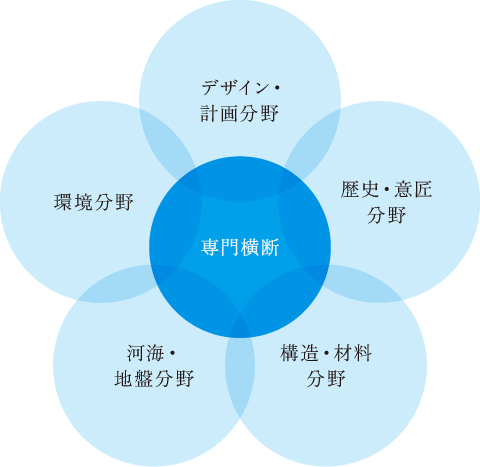
The Architecture, Civil Engineering and Urban Design encompasses a wide range of technical fields, and the fields are deeply interrelated. Therefore, the department has organized an educational curriculum that includes five fields to enhance the expertise of the basic faculties: "History and Design," "Design and Planning," "Environment," "River and Marine Engineering and Soil," and "Structure and Materials," as well as "Cross-disciplinary" to ensure the integration of these fields.
Our goal is to nurture students to become specialists and highly skilled engineers with a broad perspective who can master the advanced knowledge and skills in their respective fields, as well as understand and use the technologies related to these fields in an integrated manner.
Architecture Course
In the Architecture course, students will acquire broad, highly specialized knowledge, methodologies, and ethics in each field of architecture, and will develop the ability to proactively identify societal demands for architecture and to be involved in solving them.
-
Key Points of the Architecture Course
01 Conducting advanced and accurate structural testing using a loading device that can reproduce component stress during an earthquake
In this course, faculty members and graduate students work together to conduct structural experiments in order to establish quantitative methods for evaluating the structural performance of architectural structural members and frameworks. A wide variety of experiments are conducted on RC column-S beam joints, RC columns, steel frame braces, steel frame column bases, wooden earthquake-resistant walls, earthquake reinforcement of cultural heritage buildings, and seismic isolation and vibration control devices, and the results of these experiments are published in papers both in Japan and overseas, and these research findings are being utilized in society.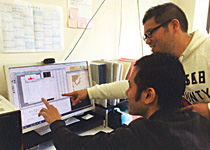
02Initiatives to improve earthquake disaster prevention by analyzing the vibration of entire buildings during earthquakes, and by conducting detailed analyses of seismic isolation and vibration control devices and seismic resistance elements
In order to reduce damage to buildings caused by earthquakes and to design buildings that can maintain their functionality even after an earthquake, we are improving the accuracy of analysis of the vibration characteristics of buildings caused by earthquake motion.In addition, we are improving our analysis technology by understanding the destruction phenomenon and proposing more rational design methods and more advanced modeling methods through detailed finite element (FEM) analysis that can accurately reproduce structural experiments for seismic isolation and vibration control devices and seismic elements.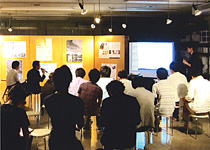
03Developing comprehensive design capabilities that foster realistic design concepts and ideas that break through conventional concepts
In this course, students will actively participate in architectural design competitions held outside of the university, raising questions about preconceived notions that have become a formality in modern society and cultivating design ideas that will pave the way for the future. In addition to fostering these creative ideas, we also focus on developing the skills required for real design activities. Through architectural studio training in which students create everything from basic design drawings to specifications and detailed drawings, and same-day design assignment exercises, students will develop the ability to read given conditions and create design proposals in a short amount of time.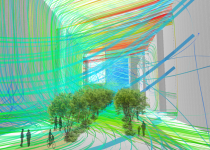
04 Proposal of a new era of design methods to improve the environmental performance of cities and buildings
Nowadays, environmentally friendly architecture is gaining importance. In order to realize a more comfortable and energy-efficient society, we conduct research using measurements of thermal, air, and lighting environments and various simulations. In order to apply the results of our environmental engineering research to actual design sites, we also work on problem solving through joint projects with architects and urban planning experts, and propose new prediction formulas and design methods by making full use of data analysis, CAD, airflow analysis, reverse analysis, AI, etc.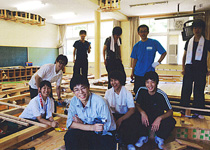
05Social implementation of technology and research developed through participation in socially relevant projects
It is important to go beyond desk research and go out into the real world to design, plan and construct a part of the research results in reality when studying architecture. In this course, each laboratory participates in various projects. In particular, a large-scale project to renovate a closed elementary school in Kawakami Village, Nara Prefecture, is currently being used by students of the University of Tokyo as well as other universities and educational institutions as the Environmental Education Center Kawakami Village Genryu Branch. In addition, we are actively engaged in research and practice while engaging with society in Kita-ku, Konohana-ku, Asahi-ku and Sumiyoshi-ku in Osaka City, Sumoto City and Amagasaki City in Hyogo Prefecture, Sayo Town in Hyogo Prefecture, Fushimi-ku and Nishikyo-ku in Kyoto City, and the Osaka Kita Chamber of Commerce and Industry.
Urban Design Engineering Course
In the Urban Design Engineering course, students learn a wide range of advanced technologies and concepts for the development, maintenance, and management of social infrastructure that can coexist in harmony with the natural environment, focusing on cities and regions and the human activities carried out there.
-
Key Points of the Urban Design Engineering Course
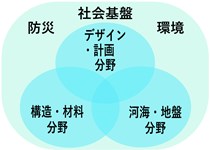
01Aim to become a professional or highly skilled engineer who can comprehensively understand and utilize the technologies in various fields related to social infrastructure.
The social infrastructure that urban design engineering focuses on refers to the fundamental facilities and systems that support safe and secure lifestyles and economic activities in cities and regions. The technical fields involved are broad and deeply interrelated, so in this course students will gain an integrated understanding of the fields of "design and planning," "structure and materials," and "river, sea, and ground," and will learn advanced knowledge and technology in each field. In the future, students will aim to use the knowledge and technology they have acquired to become specialists and highly skilled engineers who can develop, maintain, and manage the social infrastructure that supports a safe and secure society in harmony with the natural environment.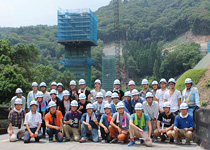
02We will proactively conduct joint research with companies and government agencies to build connections with experts in various fields.
In urban design engineering, we value our network with the companies in charge of actual design, construction, and maintenance, and with the government that manages urban spaces. Taking advantage of our location in Osaka City and our unique educational and research environment, we are actively engaged in collaborative research with outside organizations.By working on research and projects with companies and government agencies, you can meet people at the forefront of each field and learn urban development skills directly from experts. This will be a valuable opportunity to build relationships in the construction industry and other creative fields, which place importance on connections between people.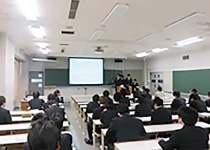
03We are proud to have a top-class number of academic presentations in order to create a forum for research discussion and to improve the quality of our research.
This course actively supports the presentation of research papers to various academic societies related to civil engineering and urban design, including the Japan Society of Civil Engineers.At these lectures and technology exhibitions, graduate students' research has been recognized outside the university, with some even winning awards for excellence. These academic presentations are a good opportunity to communicate the results of their research and development to researchers and the field, and graduate students improve their presentation and communication skills through these presentations.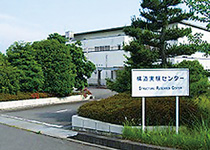
04Utilizing the largest structural testing center in western Japan, we will gain a deeper understanding of the behavior of civil engineering structures.
In research within the Urban Design Engineering course, it is crucial to conduct experiments using test specimens that are as close to the real thing as possible in order to obtain more accurate and advanced results. Our university has the largest structural testing center in western Japan at the Yawata Engineering Laboratory, and we utilize large-scale testing equipment, including load testing equipment for roads and bridges, as well as fatigue testing machines, for our research.By conducting a series of high-quality experiments like these, we can understand the behavior of civil engineering structures from various angles and new perspectives. We also have the opportunity to participate in joint research with companies and government agencies, and learn a lot from these connections with society.