





- what's new
- message
- Features
- Examples of future services
- Comments from current students and alumni
- List of each department's contents
- Facility Introduction
- Frequently asked questions
- inquiry
What’s New Latest news from the Department of Real World Computing

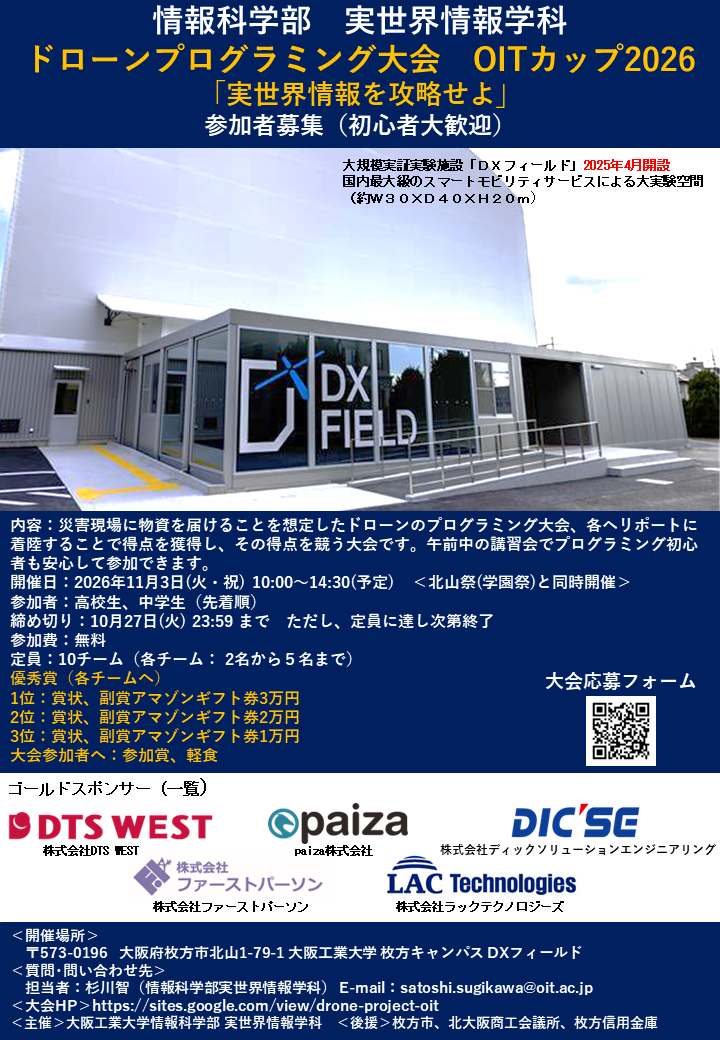
[Message from the Department Head] Digital twins and physical AI are the keys to solving real-world problems


🌟Technologies that create future services: Digital Twins × physicalAI
Have you ever had trouble finding a seat in a crowded school cafeteria or shopping center food court?
A future where such minor inconveniences are smartly resolved with the latest technology is just around the corner.
In this example, sensors attached to chairs collect real-time information on "which seats are available," and based on that information...A "digital twin" of an identical restaurant appears online.We will make it.
Furthermore, by combining past data with the current situation, congestion is simulated.If you're alone or with one other person, please take a seat at the counter. 4For groups of 10 or more, please take a table seat.In this way, the system automatically determines the optimal guidance to minimize waiting times.
In accordance with that decision,The guidance robot will guide you while avoiding tables and people, which is a physical aspect.AIRoleis.
"Where is the safest route?" "How should I move to avoid collisions?"AIThey design and then operate the actual robot.By learning these technologies that solve real-world problems using digital power, you will gain the ability to create future services with your own hands.
For more information about digital twins and physical AI, please click here .
Learning System
Learning common to all faculties
Through courses common to the Faculty of Information Science and Technology, such as programming, security, and computer science fundamentals, students will build a solid foundation for passing the 基本情報技術者 Examination and becoming an information professional.
Foundational learning in the Department of Real World Computing
UnixYou will acquire foundational skills for handling real-world information, including introductory topics, digital circuits, web programming, and media communications.
Curriculum models for honing specialized skills
There are two learning models: Digital Twin and Physical AI . Both are specialized technologies that are key to solving real-world problems, and being aware of how each learning method will be useful will lead to a higher level of learning. You can take both learning models.
Learning in the Department of Real World Computing involves a cycle of processing information collected by sensing the real world onto a digital twin, and then controlling robots, drones, and other devices based on that data. A key feature is that AI is used to recognize the current information continuously entering the digital twin, and future simulations are performed based on past data. To this end, courses on image processing and artificial intelligence are provided. Another distinctive feature is the practical application of actually operating drones and robots.
Details of the curriculum model
Digital Twin Curriculum Model
Digital twin technology allows us to copy a real-world space digitally, enabling us to simulate not only "what's happening now?" but also "what will happen in the future?"
(a) Course subjects
IoTIntroduction (1st year students )
IoTDatabases, real-world measurement, image information processing (2nd year )
IoTCommunications, IoT server construction (3rd year student )
(b)Applications that stem from learning
Optimized living environment ( smart air conditioning for comfortable seating in any classroom ) , food court where you can find a seat, less crowded commuter trains, VR simulation
(c)Research example

(d)Industries where you can thrive
Social infrastructure companies ( electricity, gas, water, transportation ) , manufacturing ( factory monitoring ) , construction industry/government offices ( smart cities )
physicalAICourse model
Physical AI is a technology that uses AI to analyze data collected in the real world and automatically control machines such as robots and drones.
(a) Course subjects
Introduction to Real-World Information (1st Year )
Artificial Intelligence, Robotics, Real-World Measurement, and Fundamentals of Real-World Information (2nd year )
Robot dialogue system (3rd grade )
(b)Applications that stem from learning
Robot and drone autonomous driving, smart agriculture, sports analysis
(c)Research example

(d)Industries where you can thrive
Automotive, robotics, logistics ( automated giant warehouses )
FeatureFeatures
-
[Classes] Cultivating the ability to create the future through cutting-edge practical learning
Immediately after enrollment, students begin taking cutting-edge classes utilizing AI, drones, computers, and IoT technologies. In courses such as "Introduction to Real-World Information," "Introduction to Computers," and "Introduction to IoT," students practice manually piloting drones and programming automatic flight, while also learning the basics of sensors and networks. From the second semester of their first year to their second year, students will acquire basic skills in programming and AI in courses such as "C Exercises I and II" and "Artificial Intelligence." In addition, through practical exercises that combine AI and programming, such as drone control using markers, students will acquire a solid understanding and ability to apply technology, nurturing their "ability to create the future."Current Student CommentsPlease also see:

-
[Laboratory] Hone your own "ability to create the future" in a variety of specialized fields that connect to the real world
Students will further hone their expertise and practical skills by aligning their "ability to create the future" that they have developed through practical learning with their interests and career paths. The Department of Department of Real World Computing aims to create the future using digital twins, and provides an environment where students can practically learn the technologies that support this, such as IoT, networks, AI, sensors, VR, and image processing.
For example, in the "Technologies that support social infrastructure" category, students can learn about smart agriculture and disaster prevention measures that combine sensors and networks, in the "Technologies that connect people and society" category, and in the "Technologies that understand people and the environment" category, students can learn about education and medical support systems that utilize AI and VR, and about topographical analysis and environmental understanding that utilize image processing and sensing technology, which will lead to the construction and application of digital twins. (The photo shows research into the introduction of sensors for plant cultivation.)Examples of special pagesPlease also take a look.)
While learning these skills, students will choose a specialization that suits them and, with the support of faculty and senior students, acquire solid specialized knowledge and the ability to apply it.

-
[Challenge to social implementation] Testing the nurtured "power to create the future" through challenges and transforming it into an unshakable power
The "ability to create the future" that students have developed in classes and in the lab will be transformed into an unshakable strength through various challenges. In the Department of Real World Computing, many classes involve problems with no correct answer, which develop the ability to identify problems on one's own, think of solutions, and work with peers to give them form. In addition, students will further improve their expertise and practical skills through activities in the lab.
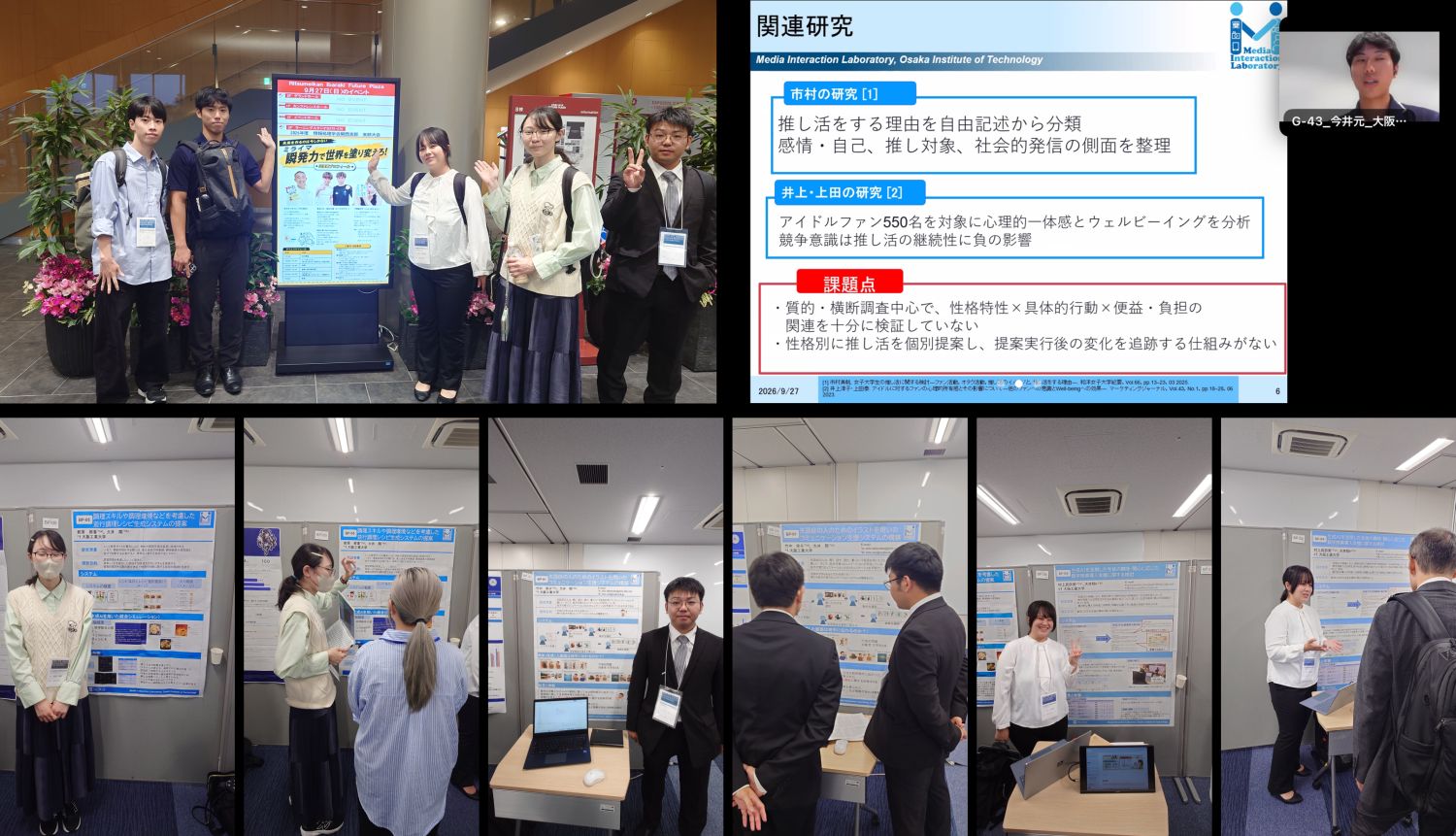
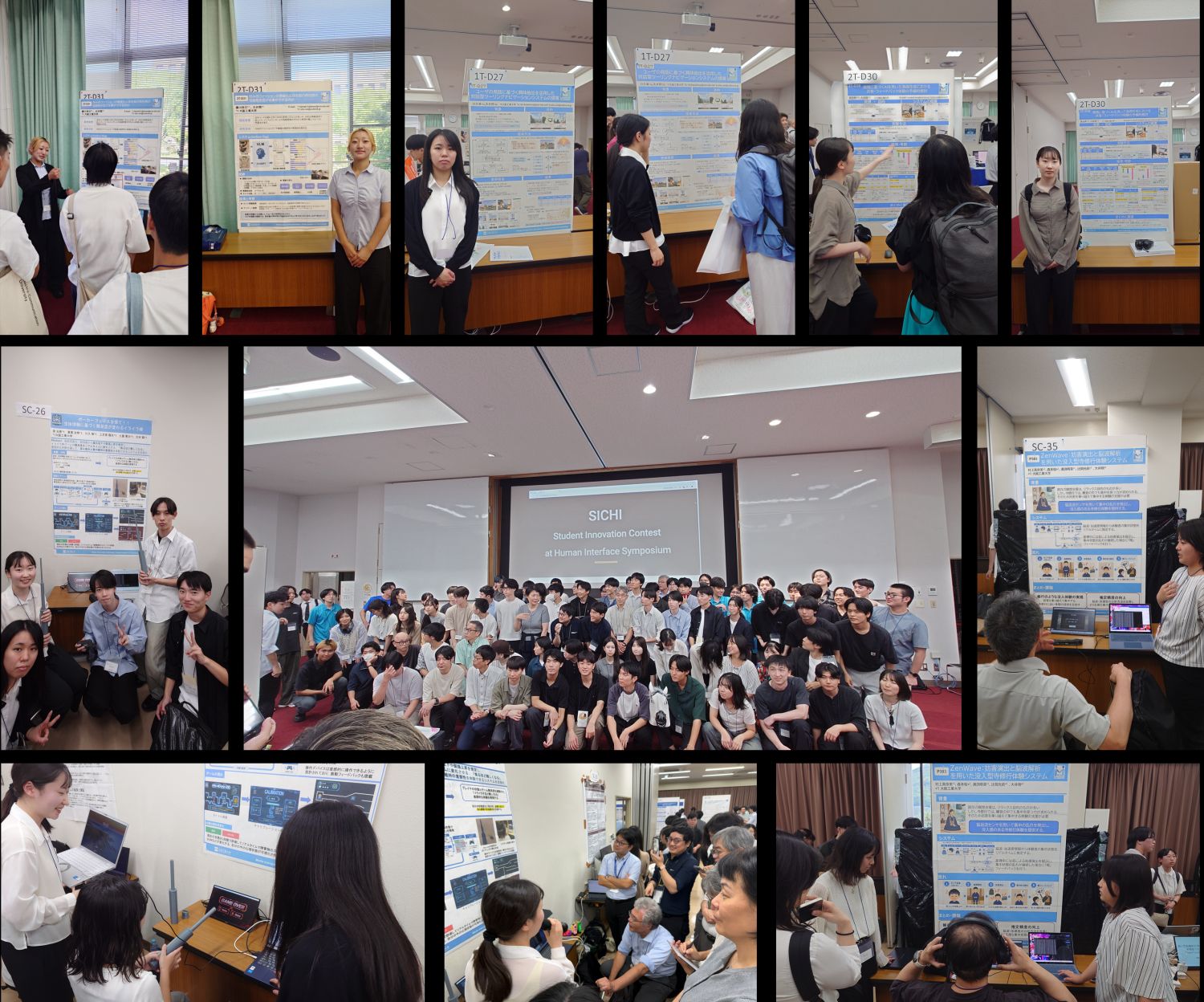
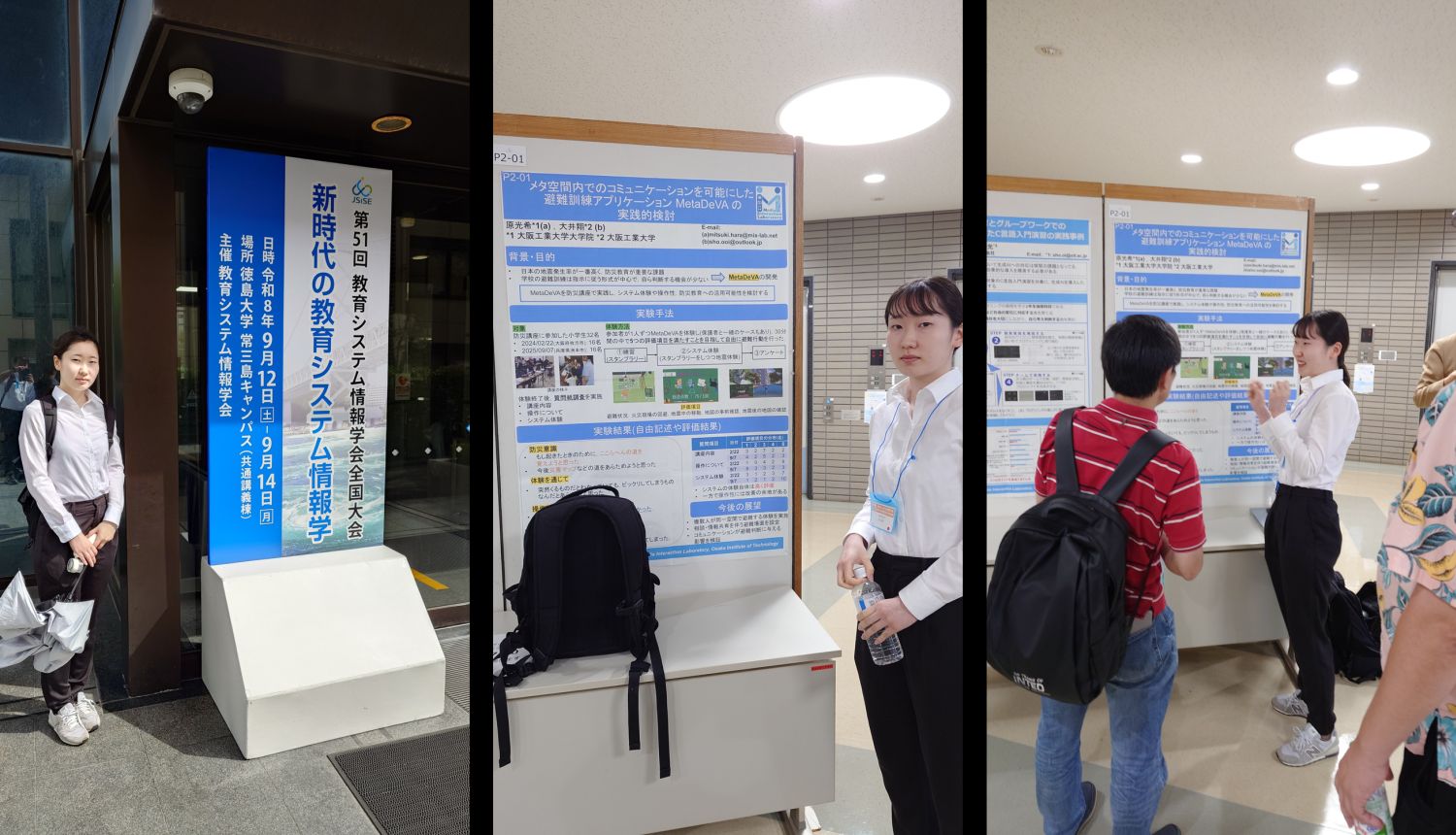
The skills cultivated in this way will grow into unshakable strength through repeated challenges. For example, there are plenty of opportunities to test the knowledge and skills learned in the real world, such as presenting papers, participating in business and programming contests, and using and exhibiting systems and apps that students have developed themselves at local events or events that they themselves organize.
By tackling these challenges, students will acquire not only expertise but also comprehensive abilities such as problem-solving skills, execution skills, and collaboration skills, and will be able to play an active role in various fields of society. Please see What's New for the latest examples of student success.

-
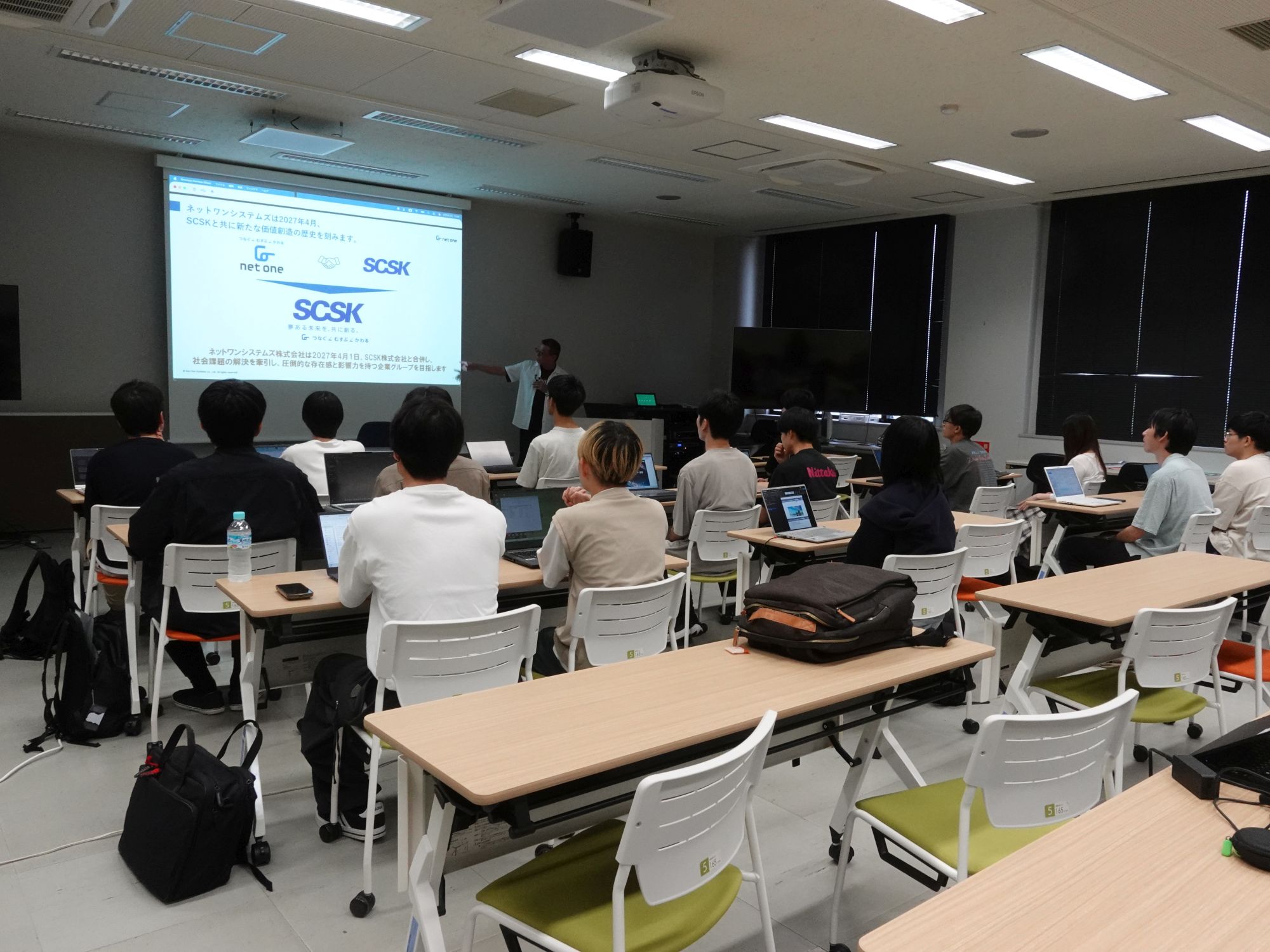
[Practical Learning with Companies] (Special lecture to be held in 2026, regular course from 2027)
The Department of Real World Computing and the Department of Information and Computer Science will invite Assistant Professor from major companies active in society to offer courses in which students can learn how the latest technologies are being used in business operations.
The Assistant Professor are experts from four companies: Mitsubishi Electric, NTT Data MHI Systems, KDDI Research, and Ricoh.
After the lectures, we will conduct active learning activities through group work and discussions, where students will consider "how they would utilize" technologies such as AI, IoT, physical AI, digital twins, and drones/robots. This learning experience, which is closely connected to companies, will be a great asset when considering future careers.
The details of the special lecture in 2026 are as follows:HerePlease see.

Research Examples of future services

Future services will also involve collaboration with agriculture. Various sensors are placed on this farmland to monitor temperature and soil conditions, and this information is collected in a digital twin of the farmland. The research involves predicting the best time to harvest and controlling robots accordingly to harvest and store the crops in warehouses. Furthermore, it will address the labor shortage problem in Japanese agriculture by using physical AI to navigate to harvesting locations and by using robots that automatically track people to automatically transport crops. To realize smart agriculture of the future, we are conducting joint research with the Faculty of Agriculture at Setsunan University and various companies.

The robot constantly recognizes its own location within the city (self-localization) by receiving information from its onboard LiDAR (optical distance sensor), a 3D map of the city replicated in the digital world, and positioning information from satellites.
The city map is overlaid with dynamic information such as crime rates and traffic congestion in real time. Based on this information, AI plans and sends the optimal route to the robot in response to the request. For example, an ordinary user in the city can send a delivery request from any point, and the robot will deliver the goods via the fastest route to the destination.
In addition, based on crime information, they will focus on patrolling areas where crime prevention is particularly important, thereby keeping an eye on citizens so that they can live in peace.

Voice Shooting: A New Experience Aiming with Your Voice! This research develops "Voice Shooting," a game where you aim at targets using your voice. The user's voice becomes the "bullet," and they aim at prizes in AR (Augmented Reality). Furthermore, it incorporates a mechanism where real objects move in response to the voice, utilizing physical AI technology where AI interacts with the real world. In addition, by using the concept of a digital twin, which maps the AR space to real-world objects, users can experience a connection between the digital and real worlds. Because it allows for voice training while having fun like a game, it is expected to have applications in health promotion and communication support.
Simulation within the International Space Station: Transmitting information obtained in space to Earth is a crucial role. Robots play a vital role in this, for example, by relaying the status of astronauts to the ground. However, actually operating and controlling robots on the space station incurs significant costs. Furthermore, there is the challenge that astronauts currently need to directly operate them. Therefore, this research aims to reproduce the interaction between an astronaut model and a robot in a simulator and apply the results to actual robots. Using a simulator allows for safe and low-cost testing of various situations, enabling the prior identification of potential problems.
Students & Graduates Voices Comments from current students and alumni
(Mitsuki Iwakura, 2nd year Department of Real World Computing)
In the first semester's "Introduction to Real-World Information" course, we gained knowledge that will lead to qualifications, and we had the opportunity to handle drones from the very first lesson, which allowed us to learn things through experience that we wouldn't learn just by listening. It was a great thrill when we were able to fly a drone just as we had intended, and it was a great attraction to be able to understand how information technology can be useful in society through such experiences.
The professor said that the "C Seminar I" that starts in the second semester is quite difficult, but I expect that it will help me to gain more skills. I'm looking forward to taking on the challenge.
(Daiki Kawashima, 2nd year , Department of Real World Computing)
The lecture involves students working in groups of three attempting seven tasks, none of which have a clear correct answer, and the content is such that it would be difficult for one person to solve it alone.
That's why I found the time I spent repeatedly discussing with my colleagues how we could solve this problem and going through trial and error to be very enjoyable and a very practical learning experience.
Furthermore, through group work, I naturally had more opportunities to interact with many people. I made many friends who went beyond the boundaries of lectures and helped each other with areas I was weak in, and who would hang out after class.
In this class, I felt that I gained the ability to think and act together with my peers while facing issues that are similar to those in real society.
(Graduate of Intelligent Media Communications Laboratory NTT Docomo Business Keisuke Hara)
In developing PaaS, I have the opportunity to come into contact with a variety of technologies, such as exchanging huge amounts of data obtained from IoT devices, remotely controlling robots, and developing services linked with AI, and I learn something new every day.
The curriculum of the Department of Real World Computing is an ideal place to come into contact with these cutting-edge fields and develop a challenging attitude. Not only the knowledge you gain in class, but also the discussions you have with your lab colleagues and professors, and the experience of getting your hands dirty and going through trial and error will surely be useful once you enter the workforce. We encourage you to broaden your interests while you are a student, and work hard, believing in your own potential.
(Networking Laboratory Graduates NetOne Systems Co., Ltd. Takuya Miura)
I believe that by gaining a solid understanding of these fundamentals and then working in applied fields such as IoT, drones, and robotics, students will be able to grow into engineers who can realize more advanced technologies. This curriculum, which systematically teaches the basics and applications, networks, and cutting-edge technologies, is expected to enable students to systematically acquire the fundamental knowledge needed to work with cutting-edge technologies and practical skills that can be used in the field.
ContentsList of each department's contents
-

curriculum
Please click here for more information on the four years of study, lecture content, and global human resources.
-

Laboratories and Faculty
In a variety of laboratories and under the guidance of highly qualified faculty, you can learn the knowledge and practical skills necessary to solve various social issues using information science and technology.
-

Employment and Career Paths
Find out more about the paths and employment opportunities available to you after graduation. Check out the diverse career possibilities available to you.
Three Policies of the Department of Real World Computing
FacilityFacility Introduction
-
A vast campus towering over Hirakata.
The vast campus, located in northeastern Osaka, is equipped with a wide range of facilities related to information science.
Surrounded by a quiet residential area, you can study and participate in extracurricular activities in a peaceful environment.
-
The birth of "DX Field," which connects society and changes the future
It will be a base for practical research, education, and on-campus ventures in smart mobility services. It will be a suitable facility for nurturing rich creativity by pursuing academic theories from diverse perspectives in the Faculty of Information Science and Technology, which conducts education and research such as collecting real-world information, analyzing the data, and reproducing it in virtual space.

Q&AFrequently asked questions
-
What kind of department is the Department of Real World Computing? What makes it different from other departments?
This department equips students with the ability to solve various problems occurring in the real world using information science and technology. While all Faculty of Information Science and Technology have the ability to acquire skills in programming and using AI, the Department of Real World Computing is characterized by its applied approach to solving real-world problems, such as using information science and technology, including AI, to control drones, robots, and various environmental devices. -
This is a new department, but what kind of jobs will it lead to?
Although this is a new department, employment support will be provided by the Faculty of Information Science and Technology as a whole, so we expect a high employment rate (98.8%: 2023), just as we have achieved in the past. Expected jobs include IT (information technology) companies and software development companies where students can utilize their programming and AI skills, as well as electronic equipment manufacturers that utilize IoT (Internet of Things). -
What skills can I acquire in piloting a drone?
In classes such as "Introduction to Real World Information," students can learn about the laws and basic piloting techniques required to operate drones, and by participating in research projects, students can receive advice on written exams and piloting techniques from affiliated drone schools, and can practice drone piloting techniques by utilizing the DX field in the new facility. By gaining training through these programs, students can also aim to obtain the national qualification "Unmanned Aerial Vehicle Pilot Proficiency Certification System (Pilot License System)." -
Could you please tell me about tuition fees, access to campus, and entrance exam information?
Please see our entrance exam page .
ContactInquiries and Access

Faculty of Information Science and Technology Office Hirakata Campus Building 1, 1st floor
Reception hours: Weekdays 9:00-17:00
Please note that it may take some time to respond to inquiries during the summer and winter holidays.