





NEWS RELEASE【No.20】
A research group from the Department of Applied Chemistry at Osaka Institute of Technology (President: Susumu Inoue), including Associate Professor Tomoyasu Hirai, Assistant Professor Wataru Kashiwara, and graduate students Towa Shinoda and Mayu Mine (then second-year master's students) in the Department of Applied Chemistry, Environmental and Biomedical Engineering, Environment and Life Engineering, along with Associate Professor Ming-Chia Li and undergraduate student Chia-Yu Lin of National Yang-Ming Chiao Tung University in Taiwan (President: Chih-Hung Lin), has developed a new material that controls the energy flow of molecules that receive light, inspired by the mechanisms of photosynthetic bacteria. The material utilizes helical nanospaces formed by polymers to simultaneously achieve "photon upconversion (TTA-UC)," which converts low-energy light into higher-energy light, and "circularly polarized light emission (CPL)," which vibrates in a clockwise or counterclockwise helical pattern. Furthermore, while oxygen is a major inhibiting factor for TTA-UC, the rapid energy transfer achieved has resulted in a groundbreaking achievement: enabling observation in air.
The results of this research were published on October 2, 2026, in the Journal of the American Chemical Society, the top chemistry journal of the American Chemical Society (ACS).
|
[Key points of this matter]
|
-
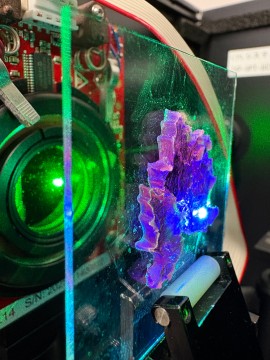
Circularly polarized upconversion luminescence achieved in air
The term "photosynthesis" generally brings to mind plants. However, photosynthesis is not limited to plants; some bacteria also perform it. For example, green sulfur bacteria inhabit lakes, hot springs, and other areas rich in sulfur where light is scarce, and perform a unique type of photosynthesis that does not produce oxygen. To efficiently utilize limited light energy, green sulfur bacteria form a characteristic light-harvesting structure in which pigment molecules are regularly arranged. In such in vivo light-harvesting systems, pigment molecules are not randomly distributed but are arranged in regular spaces on a nanometer scale, allowing for efficient transfer of light energy.
This research drew inspiration from the natural mechanism of "controlling the flow of light energy by arranging molecules in a regular nanoscale space." Based on this idea, we utilized a composite complex*1 formed from polymers with different stereoregularities to construct a helical nanoscale space surrounding light-capturing molecules (photocapture molecules) and light-emitting molecules (luminescent molecules). Within this nanoscale space, the photocapture molecules enter an excited state where they temporarily store light energy, and this energy is then transferred to the luminescent molecules.
In this study, we discovered that in addition to the rate of energy transfer, the rate of energy transfer between light-emitting molecules can also be accelerated. This makes it possible to transfer energy faster than energy is lost (deactivated) by oxygen, and we found that energy can be efficiently utilized even in air where oxygen is present. As a result, we succeeded in realizing TTA-UC, which converts low-energy light to high-energy light, in air, and simultaneously realizing circularly polarized emission, in which the polarization state of the light reflects the helical structure, through chiral*2 helical nanospaces.
This research demonstrates a novel approach to material design that controls the competition between oxygen-induced deactivation and energy transfer, and simultaneously controls the flow of light energy and the polarization state of light, not by "changing the molecules themselves," but by "designing the nanoscale space in which the molecules reside." This technology is expected to be applied to energy conversion materials utilizing sunlight and light-emitting/optical information devices utilizing polarization. Furthermore, by changing the types and combinations of molecules incorporated into the nanoscale space, it is anticipated that this will lead to the development of new optically functional materials capable of utilizing and converting light of various wavelengths.
When a 532-nanometer laser beam (green light) is shone onto a sample (pink gel), upconversion emission (bluish-white light) is observed, where low-energy light is converted into higher-energy light. By incorporating light-emitting molecules into helical nanospaces formed from polymers with different stereoregularities, energy transfer during the transition from an energetically stable state to an unstable state is controlled, resulting in rapid TTA-UC emission in air.
Glossary:
*1 Complex: A compound in which another molecule or ion is bonded to a central atom or ion.
*2 Chiral: A molecule that has the property of not being able to superimpose its image on a mirror, like the relationship between a right hand and a left hand.
This research was supported by the Japan Society for the Promotion of Science Grants-in-Aid for Scientific Research (C) JP22K05245, the New Energy and Industrial Technology Development Organization (NEDO) Moonshot Research and Development Program JPNP20003, and the OIT Research Fund.
Paper information
Paper title Helical Nanocavity-Driven Upconversion Circularly Polarized Luminescence with Efficient Triplet Dynamics in Poly(methyl methacrylate) Stereocomplexes
(Translation: Helical nanospace-driven upconversion circularly polarized light emission achieving efficient triplet dynamics in poly(methyl methacrylate) stereocomplexes)
Authors: Towa Shinoda, Mayu Mine, Wataru Kashihara*, Arisa Gono, Ayano Tokoroyama, Chia-Yu Lin, An-Ting Pan, Noboru Ohta, Yoshinobu Nakamura, Syuji Fujii, Tatsuo Nakagawa, Hiroaki Hanada, Ming-Chia Li*, Tomoyasu Hirai* (*Corresponding author)
Journal name: Journal of the American Chemical Society
DOI 10.1021/jacs.6c16205
URL https://doi.org/10.1021/jacs.6c16205
Publication date: October 2, 2026 (online publication)
■Contact information for inquiries regarding the content
Tomoyasu Hirai, Associate Professor, Department of Applied Chemistry , Osaka Institute of Technology Faculty of Engineering
TEL: 06-6167-5125 (If unavailable, please contact the Public Relations and Planning Department of Josho Gakuen School Corporation)
■Department responsible for this matter and for media inquiries: Public Relations and Planning Department, Josho Gakuen Educational Foundation (Contact persons: Ishimura, Hasegawa)
TEL: 06-6954-4026 Koho[at]josho.ac.jp
*Please replace [at] in the email address with @.