





NEWS RELEASE【No.10】
A research group led by Associate Professor Masaharu Kobayashi of the Department of Applied Chemistry at Osaka Institute of Technology (President: Susumu Inoue) has discovered a simple method for producing various oxidized sterols that are involved in the growth and efficacy of mushrooms, and has clarified the precise three-dimensional structures of sterols, which had previously been unclear. Sterols are molecules produced in the bodies of plants, animals, and fungi, and are thought to be deeply involved in the efficacy of food. The results of this research are expected to lead to the elucidation of the three-dimensional structures of highly oxidized sterols and the in vivo synthesis process (biosynthetic pathway) of sterols, which will be useful in the development of pharmaceuticals and other applications.
| [Key points of this matter] ● Use chemical species that can exist in living organisms to synthesize a wide variety of sterols simply and comprehensively. ● Developed a method to directly introduce oxygen functional groups into the CD ring of the steroid skeleton, a method with few precedents. ● Elucidated the three-dimensional structure of the quaternary carbon center of the steroid skeleton, which was difficult to analyze using conventional methods. |
-
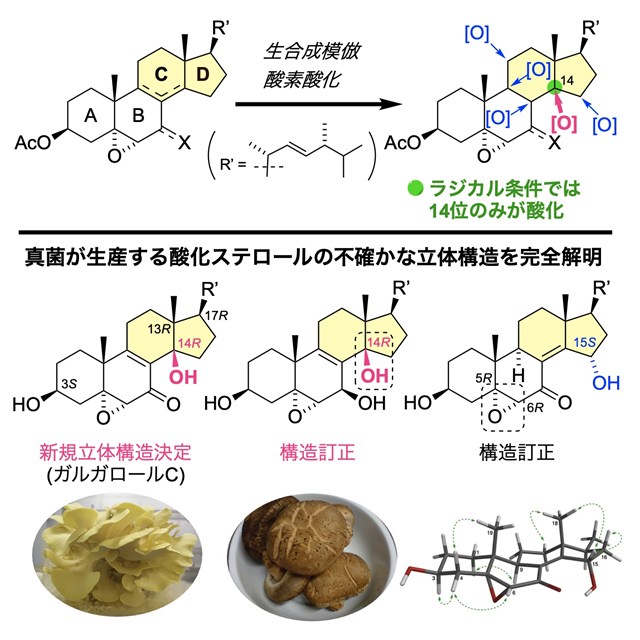
Summary diagram of this research
Sterols are one of the main components produced within plants, animals, and fungi. In animals such as humans, they are mainly produced from cholesterol, while in fungi, they are mainly produced from ergosterol. Furthermore, in fungi such as mushrooms, sterol components are thought to be deeply involved in taste and efficacy. The diversity in the structure of sterols produced by fungi is thought to be due to the oxidation of various parts of the steroid skeleton* through oxidative metabolism within the fungal body, which leads to various functional group transformations and bond cleavage and formation.
Based on a hypothesis for sterol biosynthesis that they independently devised, this research group discovered a method to directly oxidize the CD ring portion of the less reactive steroid skeleton using reaction conditions similar to those in the biological environment. In particular, they found that in radical-mediated oxygen oxidation, only the 14th position of the steroid skeleton is selectively oxidized, and that the direction of oxygen introduction (stereochemistry) is completely controlled.
Generally, sterols have a large number of carbon atoms and complex skeletal structures. Therefore, it is not easy for scientists who discover sterols from parent organisms to accurately determine their chemical structure, including stereochemistry, and erroneous reports are not uncommon. In this study, we supplied various molecules with oxidized CD rings using reliable synthetic methods, and reliably determined the chemical structures of all of them using two-dimensional nuclear magnetic resonance and single-crystal X-ray crystallography. In particular, the complete determination of the stereochemistry of the controversial quaternary carbon centers (positions 8, 9, and 14) and the disclosure of their spectroscopic data are expected to be invaluable in determining the structures of unknown sterols in the future.
-
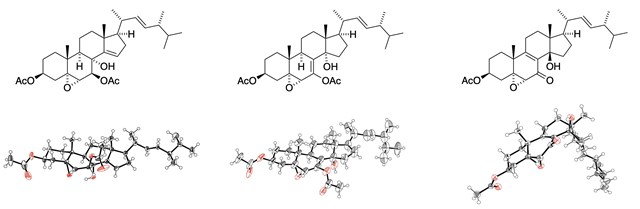
Single-crystal X-ray structural analysis of synthetic compounds
Furthermore, the research group synthesized rare oxidized sterols found in edible mushrooms such as shiitake and almond mushrooms from molecules with oxidized CD rings, and for the first time, revealed their three-dimensional structures. One of the synthesized molecules, gargarol C, has been found to have activity that inhibits osteoclast formation, and this achievement is expected to be useful in the future development of osteoporosis drugs.
The chemical synthesis conducted by this research group utilizes naturally occurring chemical species such as oxygen and iron ions, and is carried out in accordance with the inherent reactivity of the molecules. Therefore, the results of this research will contribute to elucidating the biosynthetic pathways (in vivo production processes) of sterols, which have not yet been scientifically demonstrated.
The results of this research have been published in ChemistryEurope, the flagship journal of the European Chemical Union (European Chemistry Union). (Open access, published June 18, 2026)
This research was supported by the Japan Society for the Promotion of Science Grants-in-Aid for Scientific Research (C) "24K08737".
Glossary:
*Steroid skeleton: The common matrix of sterols. It is a tetracyclic skeleton formed by the fusion of three 6-membered rings and one 5-membered ring. The rings are named A, B, C, and D, starting from the bottom left.
Publication Information: Title: Bioinspired Aerobic Oxidation to Functionalize the CD Ring of the Steroid Framework: Synthesis and Stereochemical Assignments of Gargalol C and Related Oxysterols
(Translation: Functionalization of the CD ring of the steroid skeleton by biomimetic oxygen oxidation: Synthesis and stereochemical determination of gargarol C and related oxysterols)
Authors: Hinata Togo, Yui Kanda, Shoji Kobayashi* (*First author)
Journal name: ChemistryEurope, 2026; 4: e70325. (Open Access)
DOI 10.1002/ceur.70325
URL https://doi.org/10.1002/ceur.70325
Publication date: June 18, 2026 (online publication)
■Contact information for inquiries regarding the content
Masaharu Kobayashi, Associate Professor, Department of Applied Chemistry, Osaka Institute of Technology of Faculty of Engineering
TEL: 06-6954-4081 (If unavailable, please contact the Public Relations and Planning Division)
■Department responsible for this matter and for media inquiries: Josho Gakuen Educational Foundation, Public Relations and Planning Department (Contact persons: Ishimura, Hasegawa)
TEL:06-6954-4026 Koho[at]josho.ac.jp
*Please replace [at] in the email address with @.