




NEWS RELEASE【No.11】
A joint research group led by Professor Hideji Fujii (also Professor Emeritus at Chulalongkorn University, Thailand) of the Department of Applied Chemistry, Faculty of Engineering of Engineering, Osaka Institute of Technology Institute of Technology (President: Susumu Inoue), and Associate Professor Apichat Imyim of the Department of Chemistry, Faculty of Science, Chulalongkorn University (President: Bundhit Eua-arporn), has successfully developed liquid droplets (liquid marbles) that function as carbon dioxide absorbers using naturally derived materials.
| [Key points of this matter] ● Developed a new CO₂ absorption material consisting of charcoal particles derived from coconut shells and a liquid derived from amino acids. ● The "liquid marble" structure, in which the liquid is encapsulated by particles, increases the CO₂ absorption rate by approximately 2.5 times. ● Expected to be applied to environmentally friendly CO₂ capture technologies for realizing a sustainable society. |
Reducing carbon dioxide (CO₂) emissions, which cause global warming, is a global challenge. Currently, various technologies are being researched to capture CO₂, but many require large amounts of energy or use artificial materials, so there is a need for more environmentally friendly methods.
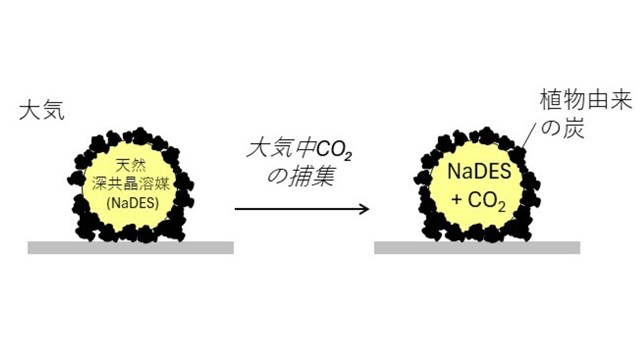
This research group has developed a new CO₂ absorbent material by encapsulating a naturally derived liquid, "natural deep eutectic solvent (NaDES)," with "biochar particles" derived from coconut shells. By creating a "liquid marble" structure in which the liquid is encapsulated in particles, the liquid inside can efficiently come into contact with air, thereby improving its ability to absorb gases. The NaDES used in this study is a highly safe liquid made from arginine, a type of amino acid, and glycerin, and it has the property of absorbing CO₂. Experimental results showed that when the same amount of NaDES was encapsulated in a liquid marble structure, it absorbed CO₂ approximately 2.5 times faster than when NaDES was simply placed in a container. Furthermore, it was confirmed that the material maintains its shape even after absorbing CO₂ and can be reused repeatedly.
Because this technology utilizes only plant resources and naturally derived liquids, it is expected to be an environmentally friendly CO₂ capture technology. Furthermore, since the liquid marble can move freely, it may be applicable to gas capture in confined spaces, which was difficult with conventional materials.
This research was supported by the Japan Society for the Promotion of Science (JSPS) Grants-in-Aid for Scientific Research (B) JP20H02803, JP24K01562, and the paper has been published online in the Elsevier journal Materials Letters (dated May 19, 2026).
URL:https://www.sciencedirect.com/science/article/abs/pii/S0167577X26009109
DOI:10.1016/j.matlet.2026.140950
DOI:10.1016/j.matlet.2026.140950
■Contact information for inquiries regarding the content
Shuji Fujii, Professor, Department of Applied Chemistry, Osaka Institute of Technology of Faculty of Engineering
TEL: 06-6954-4274 (If unavailable, please contact the Public Relations and Planning Division)
■Department responsible for this matter and for media inquiries: Josho Gakuen Educational Foundation, Public Relations and Planning Department (Contact persons: Ishimura, Hasegawa)
TEL:06-6954-4026 Koho[at]josho.ac.jp
*Please replace [at] in the email address with @.